PE is one of the most important plastic materials, with millions of tons used annually worldwide.
PE products also have favourable ecological properties:
- the recycling process is technically developed, making polyethylene recycling highly efficient.
Water transport pipes are uniformly black and opaque, marked with blue longitudinal stripes (for water), offset at 90°. Polyethylene pipes have smooth inner and outer surfaces, are flexible, and resistant to external temperatures down to -30°C.
The lifespan is estimated at a minimum of 50 years if pressure and temperature conditions, as well as installation technology, are adhered to.
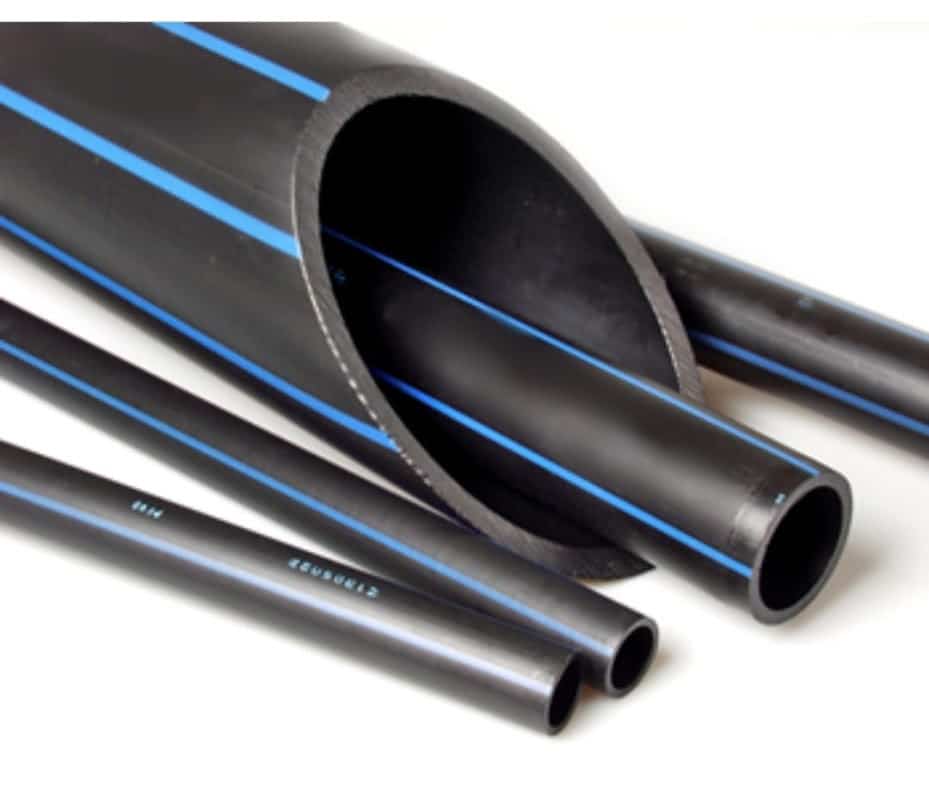
Polyethylene pipes
Water pressure polyethylene pipes are produced by extruding polyethylene granules (PE80 or PE100). High-density polyethylene (HDPE) is a thermoplastic polymer produced from ethylene. HDPE pipes are characterised by very good mechanical behaviour, excellent chemical resistance, resistance to UV radiation, corrosion, and abrasion, as well as resistance to low temperatures.
Polyethylene pipes
Polyethylene pipes have numerous areas of use, including:
- distribution networks for drinking water for household and industrial consumers;
- irrigation networks and water management;
- sewage networks, either gravitational or under pressure;
- interior sewage networks for construction;
- protection systems for electrical cables;
- transport of food or industrial liquids;
- protective pipes in thermally insulated systems.
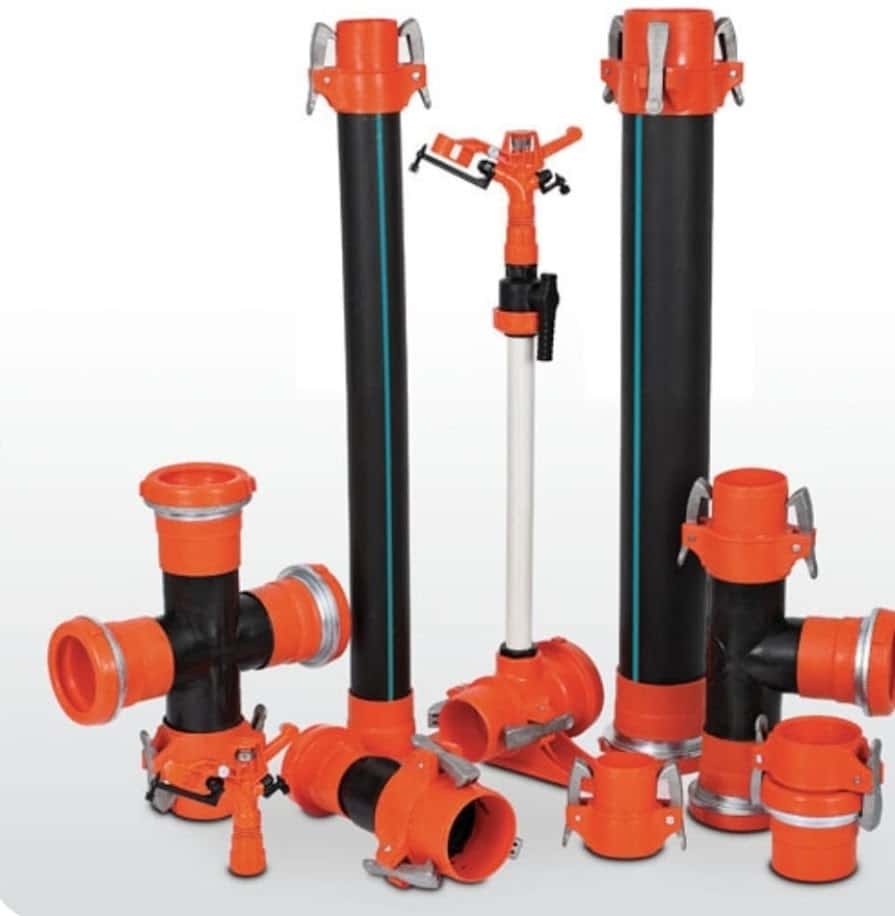
- MANEUVERABILITY The reduced weight of PE pipe system components ensures extremely high maneuverability in terms of transportation, storage, handling, and installation.
- WELDABILITY It is a fundamental characteristic of this type of system. The component parts of the system can be joined by various special welding technologies available to builders.
- PRESSURE LOSSES The inner surface of the pipes and fittings is extremely smooth, preventing material deposits inside, and pressure losses are minimized.
- FREEZE RESISTANCE The elasticity of polyethylene allows for the expansion of the pipe section if the transported liquid freezes, thus increasing its volume.
- CHEMICAL RESISTANCE Both PE pipes and fittings have high chemical resistance to most aqueous solutions, aggressive action of substances in the soil, inorganic salts, and most acids and bases even at high concentrations and temperatures.
- ABRASION AND CORROSION RESISTANCE These characteristics allow for fluid transport at speeds exceeding 7m/sec without erosion problems, even with acidic or alkaline substances with a pH between 1 and 14.
- INSTALLATION The lifespan of networks made of polyethylene is significantly influenced by how the trench is excavated, the foundation bed, and the degree of compaction.
The influence of pipe diameter, terrain characteristics, and burial depth on pipe stresses and deformations is negligible. The effect of loads due to vehicle traffic is only evident at burial depths of less than 1m. The quality of excavation works, material, and degree of compaction are decisive regarding stresses and deformations.